Short descriptions of vintage motorcycles – Matchless to Rudge
Matchless

1891, Great Britain. The story of Matchless, much like that of AJS, began with three brothers: Charlie, Harry and Bert Collier. Their father, Henry Herbert Collier, had already started producing bicycles in 1891 in a London suburb and was looking for a striking brand name — he chose Matchless.
In 1899 Charlie Collier made his debut as a racer, and in the same year the first Matchless motorcycle was developed. On his first TT ride on the Isle of Man he won the single‑cylinder class after four hours at an average speed of 61.49 km/h, achieving 3 km per litre with his 433 cm³ OHV JAP engine.
Mondial

1939, Italy.
Moto Guzzi
1921, Italy. This famous Italian manufacturer entered the international racing scene in 1924. The decisive breakthrough came in 1935 with its 250 cc class model. Stanley Woods won the 1935 Lightweight Tourist Trophy with this machine. A similar model carried Omobono Tenni to victory in 1937. It was the first non‑British motorcycle to win the Lightweight (250 cc) class of the TT and marked the beginning of the widespread use of rear suspension on road‑going motorcycles.
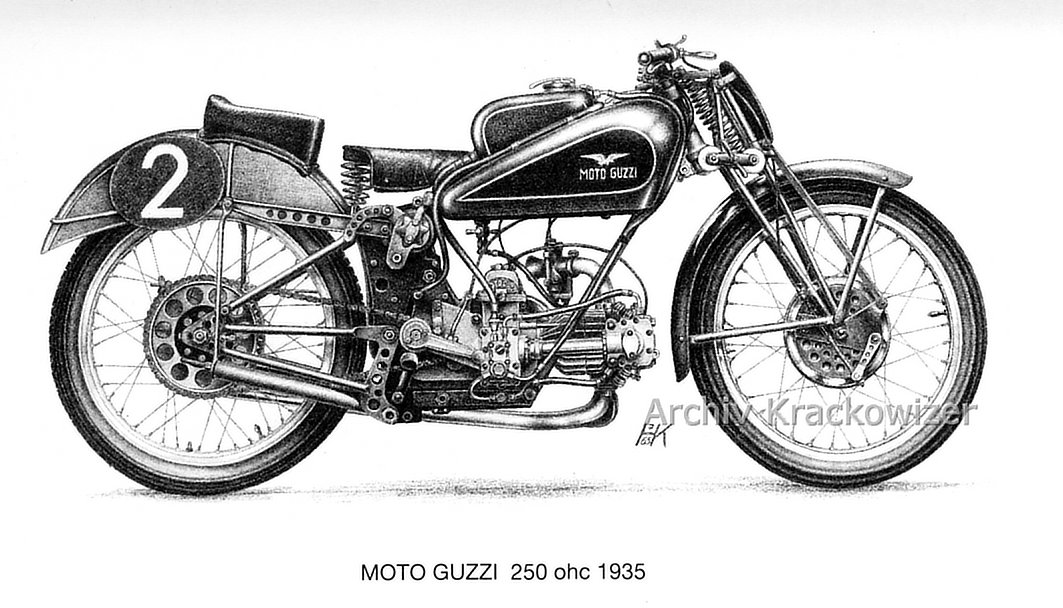
The neatly designed 250 cc OHC racing machine was introduced in 1926 and produced until 1940 with several improvements as a commercially available racer. Equipped with swinging‑arm rear suspension, it carried Stanley Woods to victory in the 1935 Lightweight TT. In 1937 Omobono Tenni repeated this success, and similar machines continued to win TT races from 1947 onwards.
Moto Morini

1924, Italy. The company’s founder, Alfonso Morini, had already used the initials “MM” before establishing Moto Morini in Bologna in 1924. In 1949 the small 125 cc two‑stroke “lighter” machines demonstrated their sporting potential by taking second and third place in the 125 cc World Championship.
Motosacoche

1899, Switzerland. Motosacoche of Geneva was once the largest motorcycle manufacturer in Switzerland and produced the world‑famous MAG proprietary engines. In 1928 the company entered the Grand Prix scene with the English‑designed 350 M 35 OHC racing machine by Dougal Marchand. In the same year Wal Handley won both the 350 cc and 500 cc European Championships on this model.
MV Agusta

1920, Italy.
Norton
1898, Great Britain. Great Britain dominated international motorcycle racing not only in the 1920s but also throughout the 1930s up to 1937. From 1931 to 1937 — except for 1935 — Norton was the leading marque. After six Senior TT wins between 1931 and 1937 with the famous long‑stroke camshaft engine, Norton appeared at the 1938 Senior TT with a much‑advanced short‑stroke engine and telescopic front fork, winning again with Harold Daniell. After the war Norton won the Senior TT three more times between 1947 and 1949.

The famous riders of the 350 cc and 500 cc DOHC works racers from 1931 to 1938 included Tim Hunt, Stanley Woods, Jimmy Simpson, Jimmy Guthrie, Freddie Frith and Harold Daniell.
After the Second World War Norton returned in 1950 with a completely new works racing model featuring the so‑called Featherbed frame, designed by the Irishman Rex McCandless. With this new Featherbed racer, Norton dominated the World Championship scene for several more years with riders such as Geoff Duke, Reg Armstrong, Ken Kavanagh and Jack Brett.
NSU

1901, Germany. In 1938 NSU developed a new supercharged 350 cc DOHC twin‑engine racing motorcycle in an attempt to reach the top of Grand Prix racing. Although it did not achieve major success before the war, the design was revived after 1945 thanks to the efforts of Wilhelm Herz. Enlarged to 500 cc, the supercharged NSU twin set several world speed records.
In the 1930s the Englishman Tommy Bullus, NSU’s No. 1 works rider, won the 1930 Klausen Race in Switzerland on the newly Moore‑designed racing model. His time of 16:41.0 for the 21.5 km hill climb remains an unbeaten motorcycle record to this day.
Peugeot

1892, France.
Puch
1903, Austria. This oldest Austrian motorcycle manufacturer achieved several sporting highlights during its existence. One of them was the victory at the 1931 “German Grand Prix” at the Nürburgring by Swiss works rider Elvetio Toricelli. Riding a water‑cooled 250 cc works machine, he defeated the previously unbeatable British makes in the quarter‑litre class for the first time.

The winners of the 1906 race on the Puch 905 — shown in the picture — were the Austrian riders Nikodem and Obruda.
An interesting endurance test was carried out by Prof. Max Reisch, who in 1933 rode a Puch 250 from Austria through Southeast Europe, Turkey and the Middle East to India. A few years later he circled the world again, this time with a Steyr‑Puch car.
Royal Enfield

1890, Great Britain.
Rudge
1869, Great Britain. The company Rudge‑Whitworth was based in Coventry. Dan Rudge began producing bicycles in Wolverhampton in 1869. At the same time the Whitworth company in Birmingham manufactured bolts and other iron goods. In October 1894 the two companies merged and settled at Crow Lane in Coventry. Initially they continued producing bicycles, but in 1910 the first Rudge motorcycle — a 499 cc model — left the factory. The first series‑production model appeared in 1911.
Until the end of Rudge production in 1939, famous riders such as Ernie Nott, Graham Walker and Tyrell Smith achieved many successes on Rudge motorcycles. With a 500 cc Rudge, Ernie Nott set the one‑hour record at Brooklands in 1930 with an average speed of 170.38 km/h.

Rudge‑Whitworth was bombed out of Coventry in 1940 and never returned to production. The company had been a pioneer of the modern four‑valve engine layout, achieving many sporting successes between 1928 and 1934, culminating in the Junior and Senior TT victories in 1930 and the Lightweight TT wins in 1931 and 1934. The so‑called “TT Replica” was the name of the production racing model — a true copy of the works racers — and was last produced in 1934.