* 1922 Helmut Krackowizer † 2001
Motorcycle legend “Mister Rudge” died on 22nd October 2001 in his 80th year.

My father passed away on 22 October 2001 in Salzburg in his 80th year of life, following his third heart attack, which he had suffered on Monday, 15 October.
This third heart attack overtook him during one of his favourite pastimes: on a glorious autumn day he had picked up one of his favourite motorcycles, a Rudge 250 cc, from a friend, transporting it on a trailer. He intended to bring it to an exhibition at the Technical Museum in Vienna. My sister and mother tried to keep him from going that day — but firstly, my father was stubborn, and secondly, nothing could ever stop him from doing anything related to motorcycles. With the motorcycle on the trailer he almost reached Salzburg‑Aigen, where he lived, before suffering the heart attack, stopping only briefly at a petrol station.
Until his death he remained a “restless spirit”, already suffering a little from not being as mobile as in earlier years. But his Vespa scooter still stood at the garden gate, ready for his daily trips into town.

Helmut Krackowizer was born on 29 April 1922 in Frankenmarkt, in the Hausruck region of Upper Austria near the Salzburg border, as the second son of Hedwig and the lawyer Maximilian Krackowizer. In 1924 the family moved to Vöcklabruck, where he grew up.
His life was shaped above all by motorcycles — but also by automobiles. “I’m forced to do something to earn a living,” he once said in an interview. When he was nine, his father took him to the Gaisberg races. As a youth he worked in mechanics’ workshops during the summer holidays and attended races. In 1939, at the age of seventeen, he was already in the saddle of a Norton “International” 500 cc.
During World War II, in 1943, while stationed on the northern German island of Fehmarn in the Baltic Sea, he read an older magazine about a Rudge for sale in Bremen. He bought it and took it with him to all his military postings until late 1944. Eventually he shipped it home to Vöcklabruck in crates. He experienced the end of the war as an officer responsible for night‑fighter radar intelligence in Norway — also on a motorcycle, but that is another story.
In autumn 1946 he took part in his first race, finishing 3rd at Salzburg‑Nonntal — in pouring rain. Numerous stories shaped his years as a racer. He met my mother while working as a technical employee at the Hatschek company in Vöcklabruck. After marrying in 1955 they moved to Salzburg. When my brother was born in 1956, my mother — as the family story goes — “turned off the gas tap” for my father. From then on he only competed in veteran rallies — but, to my mother’s dismay, always at race pace. Incidentally, he was also involved in a legendary long‑distance world record attempt with a VW 1500 in Monza.
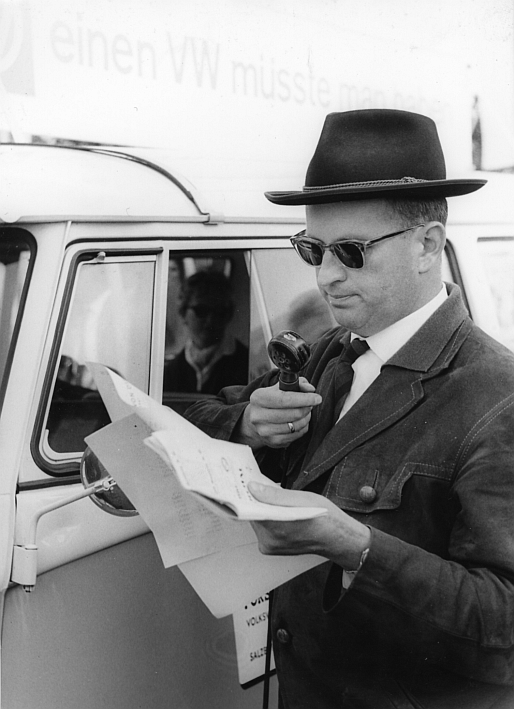
His professional career led him to complete a business degree in 1951 at the Vienna University of Economics, and one year later he joined the Eternit Hatschek company in Vöcklabruck as a “Doctor of Economic Sciences”. In 1955 he moved to Porsche Austria in Salzburg as Head of Press Affairs. He later joined Mercedes‑Benz Austria in 1964 and then British Leyland Austria in 1969. From 1976 until his retirement in 1987 he served as Public Relations Manager at Chrysler, which was later renamed Talbot and eventually merged with Peugeot.
From late 1978 to early 1982 I worked for my father in the PR department at Chrysler‑Talbot as his secretary. During that time I learned how important it is to always be well informed — “... but you must never reveal your informant!” my father explained to me.
In addition to his professional activities, he was the commentator at many races that were still permitted at the time. He often took us children with him, and so we experienced the hillclimbs on the Gaisberg, the races in Engelhartszell on the Danube, in Großraming on the Enns, the “May 1st Races”, the events on the Salzburgring and many more.
From 1965 my father began drawing. He created large‑format motorcycle drawings based on original templates, using pencils of different thicknesses. Many hours of work went into each drawing.
In 2000, a year before his death, he was still drawing motorcycles. In addition, he began writing books on the history of motorcycling, motorcycles, races and racetracks. He published articles in specialist journals in both German‑ and English‑speaking countries.
He had been an expert on nearly every type of motorcycle, knowing the history of the machines and the biographies of most racers of earlier times. His friends included, among others, Sammy Miller, John Surtees, Walter Zeller, Luigi Taveri, Hans Haldemann, Schorsch Meier and many other personalities from the world of motor racing.
He fulfilled a lifelong dream with the great veteran regularity competitions, the “Oldtimer Grand Prix” on the Salzburgring, in which stars such as Niki Lauda, Juan Manuel Fangio, the racers mentioned above and many others took part. Mercedes‑Benz sent the famous “Silberpfeile” (“Silver Arrows”) to Salzburg, and former racing riders brought their World Championship motorcycles.
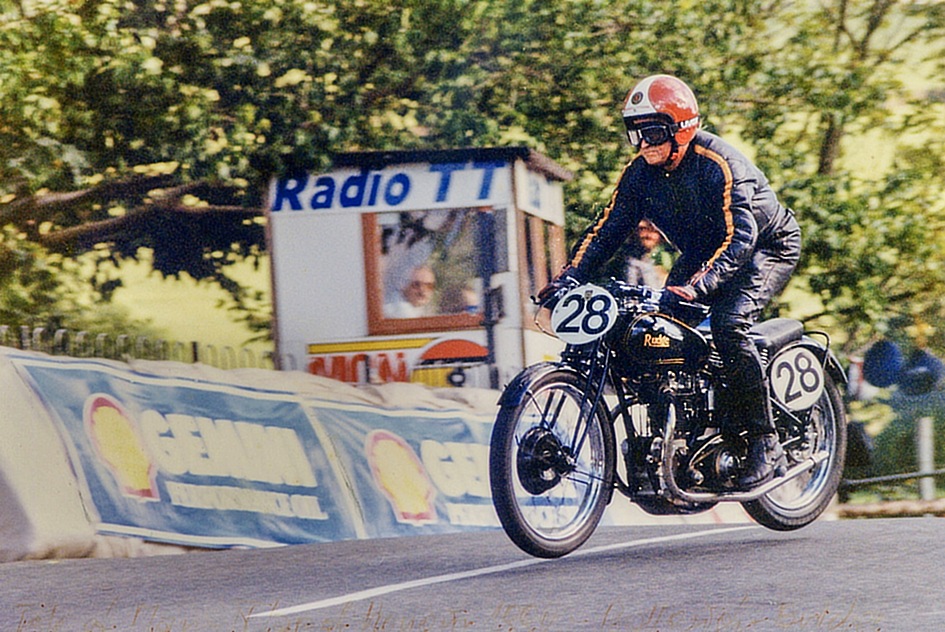
In a letter to Ernst Leverkusen, editor‑in‑chief of the motorcycle magazine “PS”, dated
23 July 1978, he described his motorsport highlights:
“First victory on the Rudge 250 on the Salzburg motorway in 1947 and Nürburgring success
on the 1929 Sunbeam in 1973.”
But the greatest event in his life was taking part in the Lap of Honour at the famous English “Tourist Trophy” on the Isle of Man in 1990 at the age of 68, as he revealed in an interview in 1996.

Until shortly before his death his licence plate number was “S‑Rudge 1”, and of course he was a member of the Rudge Enthusiasts Club in England, of which he was once the only non‑English president. He always loved travelling to England to visit friends, following the tracks of motorcycles and racing riders.
The Austrian magazine “autorevue” dedicated a story to my father in 1997, beginning with a
full‑page photograph of him on the “Sunbeam Model 90” and the quotation by the French
philosopher Gaston Bachelard (1884–1962):
“A man is the creation of his passions
and not of his needs!”
That was Helmut Krackowizer — and so he will remain in our memories.
Peter Krackowizer